

Soldering Stations
Soldering stations give you precise temperature control, fast heat-up, and consistent performance for electronics repair and assembly. Whether you’re fixing phones, building custom keyboards, or repairing gaming consoles, a proper station outperforms basic irons with accurate heat, replaceable tips, and features like auto-sleep that protect your investment. Browse our range from trusted brands including YIHUA.
Showing 1–12 of 20 results
-
Price range: £99.00 through £139.00Get JBC-compatible cartridge performance with clear LCD feedback and interchangeable...Select options This product has multiple variants. The options may be chosen on the product page
-
Original price was: £129.00.£99.00Current price is: £99.00.Get T12 accuracy and ±2°C stability in a complete 2-in-1...Add to cart
-
Original price was: £195.00.£165.00Current price is: £165.00.Get T12 soldering performance plus dual-mode hot air in one...Add to cart
-
Original price was: £139.00.£99.00Current price is: £99.00.Level up your soldering with JBC-style cartridge technology and ~2-second...Select options This product has multiple variants. The options may be chosen on the product page
-
Original price was: £169.00.£148.00Current price is: £148.00.Control temperature directly from your handle without reaching for the...Select options This product has multiple variants. The options may be chosen on the product page
-
Original price was: £265.00.£190.00Current price is: £190.00.Get professional C210 cartridge performance with 2-second rapid heating and...Add to cart
-
Original price was: £590.00.£545.00Current price is: £545.00.Double your soldering capability with fully independent A/B zone control,...Add to cart
-
Price range: £290.00 through £295.00Run two JBC-compatible handles simultaneously from one powerful station—with included...Select options This product has multiple variants. The options may be chosen on the product page
-
Original price was: £195.00.£135.00Current price is: £135.00.Tackle phone repairs, BGA rework, and screen separations with one...Add to cart
-
Original price was: £159.00.£129.00Current price is: £129.00.Tackle soldering, hot air rework, and circuit testing with one...Add to cart
-
Original price was: £69.00.£53.00Current price is: £53.00.Upgrade to professional hot air rework and precision soldering in...Add to cart
-
Original price was: £59.00.£49.00Current price is: £49.00.Achieve flawless joints with PID precision and instant visual feedback....Add to cart
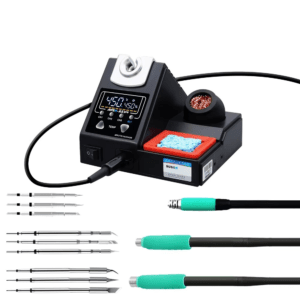
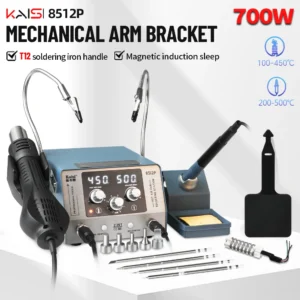


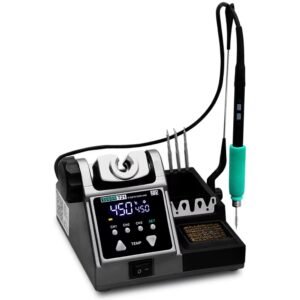
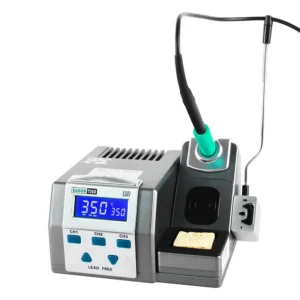
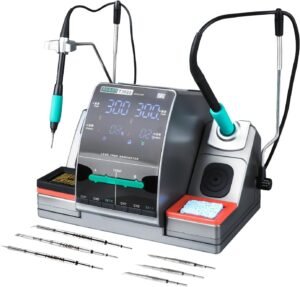


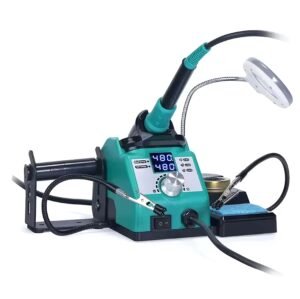
Stations for Soldering – From Beginner to Professional
Precise Temperature Control for Reliable Results
Every soldering station in our range features adjustable temperature control with digital displays. Set your exact working temperature—whether 320°C for leaded solder or 380°C for lead-free work—and the station maintains it throughout your session. PID-controlled stations like the YIHUA 939D+ III adjust power delivery in real time, so your tip stays at the set temperature even when heat transfers to large pads or ground planes. This precision means consistent joints and fewer cold solder failures.
Fast Heat-Up and Thermal Recovery
Modern soldering stations reach working temperature in seconds, not minutes. Cartridge-based systems using C210 or C245 tips heat up in approximately 2 seconds from standby, while traditional 900M-T stations typically reach temperature in under 30 seconds. Fast thermal recovery matters too—when your tip touches a cold joint, the station responds instantly to maintain heat. Less waiting means faster workflow, whether you’re doing one repair or fifty. Pair your station with quality soldering iron tips for optimal thermal performance.
Built-In Protection That Extends Tip Life
Auto-sleep functions detect when you set the iron down and reduce temperature automatically. This prevents tip oxidation during idle time and extends cartridge lifespan significantly. Many stations also include ESD-safe designs to protect sensitive components during repair work. For complete workbench setup, explore our soldering accessories including helping hands, tip cleaners, and fume extractors. Need hot air capability alongside your soldering station? Check our hot air rework stations for BGA and SMD work, or add a bench power supply for device diagnostics.
Understanding Soldering Station Tip Systems
Different soldering stations use different tip systems. Knowing which system you need helps you choose the right station and find compatible replacement tips.
| Tip System | Used In | Heat-Up Speed | Best For |
|---|---|---|---|
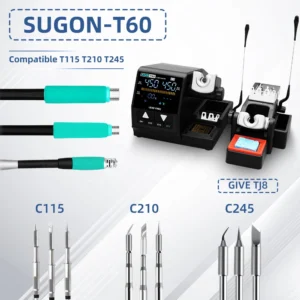
| C115 | JBC-style cartridge stations (SUGON, AIFEN) | ~2 seconds | Microscope work, ultra-fine circuits, 0402/0201 components |
| C210 | JBC-style cartridge stations (SUGON, AIFEN) | ~2 seconds | Phone repair, precision SMD, fine-pitch packages |
| C245 | JBC-style cartridge stations (SUGON, AIFEN) | ~2 seconds | General bench work, consoles, motherboards, connectors |
| T12 | T12-compatible stations | ~10 seconds | Versatile all-round use, wide tip variety |
| 900M-T | Traditional stations (YIHUA 936, 937, 939 series) | ~20-30 seconds | General soldering, hobbyist work, excellent value |
| 902 | YIHUA 902 series stations | ~20-30 seconds | Compact stations, portable use |
Cartridge Systems (C115, C210, C245) — The heater and sensor are built into the tip cartridge itself. This integrated design delivers faster heating and more accurate temperature response. Professional repair techs often prefer these for high-volume work. The trade-off is higher cartridge replacement cost.
Traditional Tips (900M-T, 902) — The heater is in the iron handle, and tips are separate components. These systems cost less to run since replacement tips are inexpensive. YIHUA stations using 900M-T tips offer excellent value for hobbyists, beginners, and repair work where ultimate speed isn’t critical.
T12 Cartridges — A middle ground combining integrated heater/sensor design with more affordable cartridge prices than JBC-style systems. Popular upgrade path from 900M-T stations.
Browse our soldering iron tips for replacements compatible with your station.
Frequently Asked Questions
Are soldering stations worth it?
Soldering stations prove their value through consistent temperature control and long-term reliability. Basic plug-in irons without temperature regulation cause frustration—insufficient heat creates cold joints that fail mechanically and electrically, while excessive heat destroys components and lifts PCB pads. Stations eliminate this guesswork.
The investment pays back quickly for anyone beyond occasional hobby use. Beginners learn proper technique faster when temperature stays consistent and they’re not fighting equipment limitations. Repair technicians recover the cost after a few successful jobs when reliable tools prevent component damage. Quality stations last years with proper care, while cheap irons burn out after months of regular use.
Temperature accuracy protects expensive components. Damaging one microcontroller or gaming console motherboard costs more than a decent soldering station. The peace of mind knowing your tools maintain proper heat across different solder types, component sizes, and work durations makes stations essential for anyone serious about electronics work.
What is the difference between cheap and expensive soldering stations?
Temperature stability marks the primary difference. Expensive stations use PID controllers that actively compensate for heat loss, maintaining set temperature within ±1-2°C even when soldering large thermal masses. Cheap stations drift 20-50°C during use because simple thermostats can’t respond quickly to changing conditions. This inconsistency creates unreliable joints and increases component damage risk.
Build quality affects longevity and user experience. Premium stations feature metal housings, robust transformers, and serviceable components that last decades with normal use. Budget models use lightweight plastics, minimal power supplies that struggle with continuous operation, and proprietary parts that make repairs impractical. The iron handpiece weight, cable flexibility, and grip comfort matter during extended soldering sessions.
Tip compatibility and availability separate good stations from cheap alternatives. Established brands like YIHUA, Hakko, and Weller use standardised tip formats with wide third-party availability. Cheap stations often require proprietary tips that become unavailable when the manufacturer discontinues the model. Replacement tip costs and selection directly impact the station’s practical lifespan and versatility across different projects.
Showing 1–12 of 20 results