

Hot Air Stations
Hot air stations give you the precision to rework SMD components, desolder ICs, and tackle PCB repairs that a soldering iron alone can’t handle.
Showing all 12 results
-
Original price was: £129.00.£99.00Current price is: £99.00.Get T12 accuracy and ±2°C stability in a complete 2-in-1...Add to cart
-
Original price was: £190.00.£165.00Current price is: £165.00.Get stable, quiet hot air rework with brushless soft wind...Add to cart
-
Original price was: £195.00.£165.00Current price is: £165.00.Get T12 soldering performance plus dual-mode hot air in one...Add to cart
-
Original price was: £380.00.£329.00Current price is: £329.00.Get 1300W professional hot air power with microcomputer temperature control...Add to cart
-
Original price was: £490.00.£445.00Current price is: £445.00.Tackle professional BGA and SMD rework with 1300W power and...Add to cart
-
Original price was: £59.00.£44.50Current price is: £44.50.Take control of your soldering accuracy with instant tip temperature...Add to cart
-
Original price was: £195.00.£135.00Current price is: £135.00.Tackle phone repairs, BGA rework, and screen separations with one...Add to cart
-
Original price was: £159.00.£129.00Current price is: £129.00.Tackle soldering, hot air rework, and circuit testing with one...Add to cart
-
Original price was: £69.00.£53.00Current price is: £53.00.Upgrade to professional hot air rework and precision soldering in...Add to cart
-
Original price was: £89.00.£64.50Current price is: £64.50.Restore delicate electronics with 740W of PID-controlled precision. It combines...Add to cart
-

-
Original price was: £59.00.£49.00Current price is: £49.00.Tackle complex soldering tasks with the YIHUA 959D Hot Air...Add to cart
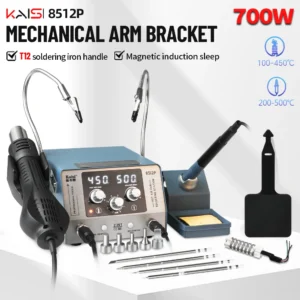
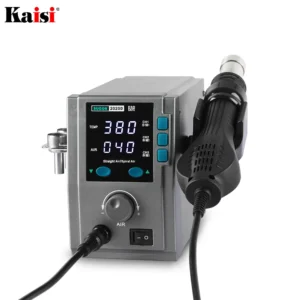

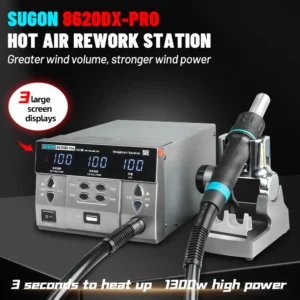
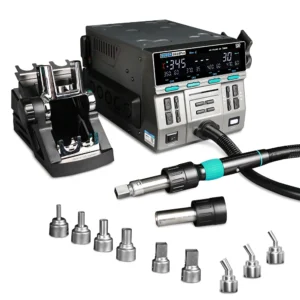


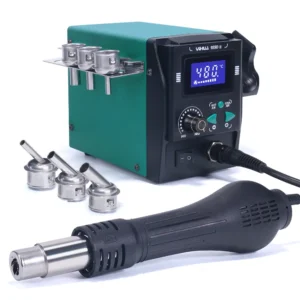
Hot Air Rework Stations for Electronics Repair and SMD Work
Whether you’re removing a BGA chip from a Switch motherboard, reflowing solder paste on a PCB, or replacing a heat-damaged IC, a hot air station gives you the controlled airflow and temperature accuracy the job demands.
A quality hot air rework station lets you work cleanly on components a standard iron can’t reach — including QFP packages, SMD resistors, and surface-mounted capacitors down to 0402 size.
Precise Temperature Control for Delicate Components
The best hot air stations use PID-regulated heating to hold a stable temperature at the nozzle. That consistency matters when you’re working on sensitive components where a 50°C swing can cause damage. Look for stations with a temperature range of 100°C–500°C and a digital readout so you always know exactly what heat you’re applying.
Adjustable Airflow for Every Job
Airflow control is just as important as temperature. Low airflow protects nearby components from being displaced. Higher airflow speeds up desoldering on larger pads and connectors. Stations with independent airflow and temperature dials — like those in the YIHUA range — give you the flexibility to dial in the right combination for each task.
Built to Work Alongside Your Soldering Station
Most electronics repairs need both hot air and a soldering iron. Many hot air stations at NeoSoldering are available as standalone units or as part of a 2-in-1 rework station, so you can consolidate your bench setup without sacrificing capability. Pair your hot air station with a soldering station, a PCB holder, and flux for a complete SMD rework setup.
What to Use With Your Hot Air Station
Getting the most from hot air rework means having the right support tools. Flux improves solder flow and reduces bridging during reflow. A preheating platform reduces thermal shock on multilayer PCBs. Soldering tweezers let you handle and place SMD components with accuracy. After rework, PCB cleaning and isopropyl alcohol remove flux residue for a clean, professional finish.
Frequently Asked Questions
What is a hot air station used for?
A hot air station blows precisely heated air through a nozzle to melt solder without direct contact. It is the go-to tool for SMD rework, BGA removal, IC replacement, and reflowing solder paste on PCBs.
What temperature should I use for SMD rework?
Most SMD rework is done between 320°C and 380°C depending on the solder type and component. Lead-free solder requires higher temperatures, typically 350°C–380°C. Always start lower and increase gradually to avoid heat damage.
What is the difference between a hot air station and a heat gun?
A hot air station offers precise digital temperature control, adjustable airflow, and interchangeable nozzles designed for electronics work. A standard heat gun lacks that precision and can easily damage sensitive components or nearby parts.
Do I need a hot air station if I already have a soldering iron?
For basic through-hole work a soldering iron is sufficient. But for SMD components, BGA chips, QFP packages, or any rework involving surface-mounted parts, a hot air station is essential. The two tools complement each other and most repair benches use both.
Can beginners use a hot air station?
Yes. Modern hot air stations with digital controls make it straightforward to learn. Starting with larger SMD components and using low airflow helps build confidence before moving on to fine-pitch ICs or BGA work.
Showing all 12 results