

Soldering Iron Kits
Soldering iron kits give you everything needed to start building, repairing, and reworking electronics straight out of the box — no guessing which iron, stand, or accessories to buy separately.
Showing all 8 results
-
Original price was: £69.00.£53.00Current price is: £53.00.Upgrade to professional hot air rework and precision soldering in...Add to cart
-
Original price was: £59.00.£49.00Current price is: £49.00.Achieve flawless joints with PID precision and instant visual feedback....Add to cart
-
Original price was: £22.90.£19.90Current price is: £19.90.Get station-quality temperature control in a portable 104g pen-style iron...Add to cart
-
Original price was: £27.90.£18.90Current price is: £18.90.Remove solder with one hand using integrated vacuum and heating...Add to cart
-
Original price was: £59.00.£38.90Current price is: £38.90.Achieve consistent soldering results with the YIHUA 937D+ Soldering Iron...Add to cart
-
Original price was: £89.00.£64.50Current price is: £64.50.Restore delicate electronics with 740W of PID-controlled precision. It combines...Add to cart
-
Original price was: £54.90.£45.50Current price is: £45.50.Remove SMD components cleanly by heating both ends simultaneously. The...Add to cart
-
Original price was: £79.00.£69.00Current price is: £69.00.Designed for efficiency, the YIHUA 939D+ III EVO combines powerful...Add to cart

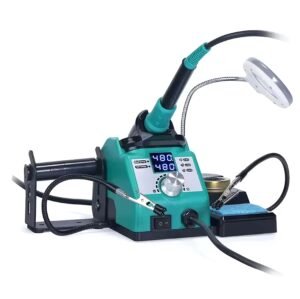


Soldering Iron Kits for Beginners and Intermediate Electronics Enthusiasts
A soldering iron kit removes the most common barrier for anyone starting out — not knowing what to buy. Instead of piecing together a station, iron, stand, and cleaning tools individually, a kit bundles the essentials into one purchase at a price that makes sense for your skill level and budget.
From compact pen-style irons like the YIHUA 928D-I to full rework stations like the YIHUA 8786D, every kit in this range is selected to match real use cases — console repairs, Arduino builds, custom keyboards, and PCB rework.
The Right Kit for Where You Are Right Now
Beginners benefit most from a straightforward station with clear temperature control and a stable stand. The YIHUA 937D+ delivers consistent, PID-regulated heat in a no-fuss package — a significant step up from unregulated cheap irons that make learning harder than it needs to be.
Intermediate users upgrading from a basic Amazon iron will notice the difference immediately with a station like the YIHUA 939D+ III EVO. At 110W with precise temperature management, it handles everything from fine SMD work to larger solder joints on ground planes without losing heat mid-joint.
For those ready to tackle hot air rework alongside standard soldering, the YIHUA 8786D combines both tools in a single compact unit — giving you the capability to reflow SMD components, desolder ICs, and handle standard PCB work without two separate stations on your bench.
Portable Kits That Go Where You Work
Not every repair happens at a desk. The FNIRSI HS-01 battery-powered soldering iron gives you cordless freedom for field repairs, on-site fixes, and situations where a mains socket isn’t available — with genuine temperature control rather than the fixed-heat approach of cheap portable alternatives.
The YIHUA 928D-I offers a different kind of portability — a 65W pen-style iron weighing just 104g that delivers station-quality temperature control without the bulk. Ideal for hobbyists who want precision in a slim, easy-to-store format.
Kits That Grow Into Professional Rework
Some kits go beyond basic soldering. The YIHUA 938BD-II pairs 740W of PID-controlled hot air with a soldering iron in one station, giving you the power to tackle BGA rework, QFP desoldering, and SMD reflow on larger boards. The YIHUA 938BD Soldering Tweezers add simultaneous dual-tip heating for clean, fast SMD component removal.
For desoldering, the YIHUA 929D-V integrates a vacuum pump directly into the iron — one tool handles heating and solder removal in a single action, faster and less awkward than switching between a separate iron and pump.
Pair any kit with soldering accessories, flux, and soldering wire to complete your setup from day one.
What to Add to Your Kit
A kit covers the core tools but a few additions make an immediate difference. Soldering wire in 0.6mm–0.8mm diameter suits most PCB and SMD work. Flux improves solder flow and reduces bridging, especially on older or oxidised pads. A fume extractor protects your health during regular sessions. Soldering iron tips in different profiles — fine conical for precision work, chisel for larger joints — expand what your station can handle as your skills develop.
Frequently Asked Questions
What should a beginner look for in a soldering iron kit?
Temperature control is the most important feature. A kit with a digital display and PID regulation — like the YIHUA 937D+ — gives you accurate, consistent heat that makes learning easier and protects components. Avoid unregulated irons with no temperature readout; they make good soldering harder than it needs to be regardless of skill level.
Is a soldering station better than a standalone iron for beginners?
For most beginners, a station is the better starting point. The separate base unit provides stable temperature control, a proper iron holder, and tip cleaning tools in one setup. Standalone irons like the YIHUA 928D-I suit users who need portability or already have a stand and accessories.
What is the difference between a soldering station and a rework station?
A soldering station provides a controlled iron for standard through-hole and SMD soldering. A rework station adds a hot air gun for reflowing solder paste, removing SMD components, and desoldering ICs — tasks a soldering iron alone cannot perform cleanly. The YIHUA 8786D and 938BD-II are rework stations that include both tools.
How much should I spend on my first soldering kit?
For occasional hobby use, an entry-level station handles most beginner projects well. If you plan to work regularly or tackle SMD components, investing in a mid-range station gets you better thermal recovery, more stable temperature control, and a setup that won’t need replacing as your skills improve. The YIHUA 937D+ is a solid starting point, and the 939D+ III EVO suits anyone ready to take on more demanding work.
Can I use a soldering kit for console repairs and SMD work?
Yes, provided the station offers accurate temperature control, and you use the right tip profile. Fine conical or 0.5mm chisel tips suit SMD work on console motherboards and small PCBs. For removing SMD components cleanly, adding soldering tweezers or upgrading to a kit with hot air capability gives you the full range of tools needed for console modding and phone repair.
Showing all 8 results