

All three tools solve the same problem — removing solder from a joint — but at different scales and precision levels. Desoldering wick suits small, precise jobs. A solder sucker clears larger through-hole joints fast. A desoldering gun or hot air rework station handles repeated, professional-level work. Most hobbyists end up owning more than one.
TL;DR
- Desoldering wick is best for small, precise jobs and SMD work. It’s cheap, slow, and needs a steady hand.
- A solder sucker (desoldering pump) removes larger blobs of solder fast, ideal for clearing through-hole joints before pulling a component.
- A desoldering gun or hot air rework station is the fastest and cleanest option for repeated professional-level desoldering, but costs more.
- Most hobbyists end up owning both wick and a pump. They solve different problems rather than compete directly.
- If you only buy one tool, a solder sucker handles more situations than wick alone.
UK stock · dispatched within 2 business days · free UK shipping on every order · 60-day returns · 12-month warranty
What Is Desoldering Wick?
Desoldering wick, also called solder wick or desoldering braid, is a flat, woven copper braid, usually coated in rosin flux. You press it against a solder joint with a hot iron on top, and capillary action draws the molten solder up into the braid, away from the joint.
Wick is best suited to fine, controlled work: SMD pads, tight spaces, and jobs where you need to remove a thin layer of solder rather than a large blob. It’s inexpensive and doesn’t require any extra tools beyond your soldering iron.
Advantages: cheap, precise, good for SMD and tight spaces, no moving parts to maintain.
Disadvantages: slower for large amounts of solder, uses up material with each use, can transfer heat to nearby components if left in place too long.
What Is a Solder Sucker (Desoldering Pump)?
A solder sucker, also called a desoldering pump, is a spring-loaded plunger tool. You heat the joint with your iron until the solder melts, then press the pump’s nozzle against the joint and trigger the plunger, which creates a vacuum that sucks the molten solder into the pump’s chamber.
This is the faster option for clearing solder from through-hole joints, especially when you’re removing an entire component rather than just cleaning up a small amount of excess.
Advantages: fast, reusable, better for larger volumes of solder, works well on through-hole PCBs.
Disadvantages: can be less precise than wick for tight spaces, needs occasional cleaning to stop the plunger clogging, some splatter risk if used carelessly.
What Is a Desoldering Gun or Hot Air Rework Station?
A desoldering gun combines a heating element with a built-in vacuum pump, so you heat and remove solder in a single motion rather than switching between an iron and a separate pump. A hot air rework station takes a different approach entirely, using heated air rather than direct contact to desolder SMD components and ICs, which is essential for surface-mount and BGA work where a normal iron tip can’t reach.
Advantages: fastest option for repeated desoldering, essential for SMD and BGA rework, less physical technique required per joint.
Disadvantages: highest cost of the three options, larger footprint, unnecessary for occasional hobby use.
Example Options: Pump vs Powered Station
Two real examples showing the price and capability gap between a handheld pump and a full powered desoldering station.

Handheld iron and vacuum pump in one, direct plug-in, one-handed tilt-activated desoldering. Best for occasional through-hole removal.
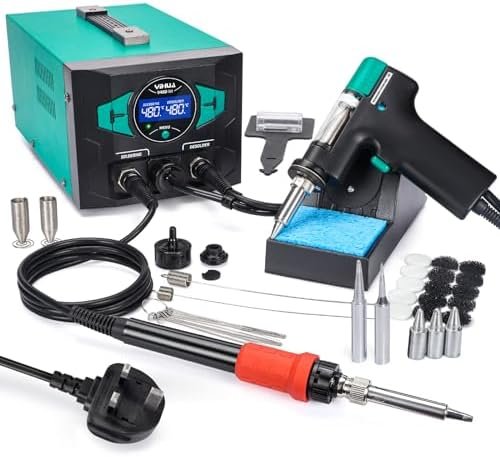
110W iron and powered desoldering gun, both PID-controlled and running simultaneously. Best for multi-pin sockets and professional repair work.
Desoldering Wick vs Solder Sucker at a Glance
| Desoldering Wick | Solder Sucker (Pump) | |
|---|---|---|
| Best for | Small joints, SMD, tight spaces | Larger through-hole joints, full component removal |
| Speed | Slower | Faster |
| Cost | Low | Low to moderate |
| Reusability | Consumable, replace the roll | Reusable, needs occasional cleaning |
| Precision | High | Moderate |
| Learning curve | Slight, needs a steady hand | Minimal |
When Desoldering Wick Is the Better Choice
Choose wick when you’re cleaning up a small amount of excess solder, working on SMD components, or fixing a bridge between two closely spaced pads. Its precision makes it the safer option in tight spaces where a pump’s nozzle simply won’t fit.
When a Solder Sucker Is the Better Choice
Choose a pump when you’re removing an entire through-hole component and need to clear a full joint’s worth of solder quickly. It’s also the better option for beginners, since the technique (heat, then suck) is more forgiving than judging how long to hold wick in place.
Common Desoldering Wick Mistakes
- Leaving the wick in place too long, which transfers excess heat into the board and can lift pads or damage nearby components.
- Using wick that’s too wide for the joint, which wastes material and cools the joint before it fully absorbs the solder.
- Reusing a saturated section of wick. Once a section has soaked up solder, move to a fresh section of the braid rather than reapplying the same spot.
- Not applying enough flux. Extra flux, even on pre-fluxed wick, often makes solder flow into the braid faster and reduces the risk of pad damage from prolonged heat.
Can Desoldering Wick Damage a PCB?
Yes, but usually only through prolonged heat exposure rather than the wick itself. Leaving the iron and wick pressed against a joint for too long can lift copper pads from the board, especially on thinner or older PCBs. Working in short bursts of 1–2 seconds at a time, rather than one long continuous press, reduces this risk significantly.
Do You Need Both Tools?
For most hobbyists working across a mix of through-hole and SMD projects, owning both a reel of desoldering wick and a solder sucker covers the large majority of situations for under the cost of a single desoldering rework station. Add a hot air rework station only once you’re regularly working with SMD components or BGA chips that a normal iron tip can’t service.
Frequently Asked Questions
Do you need solder wick to desolder?
No. A solder sucker (desoldering pump) can handle most through-hole desoldering on its own. Wick becomes essential mainly for SMD work and cleaning up small amounts of excess solder in tight spaces.
What can I use instead of desoldering wick?
A solder sucker or desoldering pump is the most common alternative, and for SMD or BGA work, a hot air rework station removes the need for either tool by lifting components with heated air instead.
Is desoldering wick just copper?
Yes, desoldering wick is a woven copper braid, usually coated in rosin flux to help solder flow into it more easily via capillary action.
Which is better, a desoldering pump or desoldering wick?
Neither is universally better. A pump is faster for clearing larger through-hole joints, while wick is more precise for SMD components and tight spaces. Most people end up using both depending on the job.
Browse the full range of desoldering pumps and soldering accessories.
Shop Soldering Accessories →