

These solve the same problem — removing solder from a joint — at very different scales. The YIHUA 929D-V desoldering pump is a £18.90 handheld tool that combines heating and suction in one device. The YIHUA 948D-III is a £169.99 full station with a separate 110W iron and powered desoldering gun running simultaneously. Most hobbyists don’t need the station. Here’s how to know if you’re the exception.
Quick answer: if you’re removing the occasional through-hole component — a capacitor, a connector, the odd resistor — the 929D-V pump handles it for a fraction of the cost. If you’re regularly pulling multi-pin DIP sockets, working through rows of components, or repairing boards professionally, the 948D-III’s continuous powered suction and dual PID control justify the price gap.
UK stock · dispatched within 2 business days · free UK shipping on every order · 60-day returns · 12-month warranty
929D-V Pump vs 948D-III Station at a Glance
| 929D-V Desoldering Pump | 948D-III Desoldering Station | |
|---|---|---|
| Price | £18.90 (was £27.90) | £169.99 |
| Format | Handheld, direct plug-in, no station | Full station, iron + desoldering gun separate |
| Operation | One-handed, tilt-activated vacuum | Both tools operate simultaneously |
| Preheat / recovery | 3-minute preheat | PID control, 20ms intervals, fast recovery |
| Suction power | Built-in pump, tilt-triggered | 0.05MPa continuous suction |
| Nozzles included | Ø1.0mm and Ø1.2mm | 4 sizes |
| Best for | Occasional through-hole removal | High-volume, multi-pin, professional repair |
Why the Price Gap Is Justified, Not Just Markup
The 929D-V combines heating and suction in one handheld unit you plug in directly — no separate station, no setup. Heat the joint, tilt to trigger the vacuum, solder is gone. It’s built for one joint at a time: removing a capacitor, correcting a solder bridge, salvaging a component from a donor board. The 3-minute preheat and single tilt-activated pump are fine for this — you’re not doing this back-to-back for an hour.
The 948D-III exists because manual pumps (including the 929D-V) become slow and risky once you’re removing a 40-pin DIP socket or working down a row of capacitors on a multi-layer board. Its 0.05MPa continuous suction clears joints without stopping to reset between pulls, and running the iron and desoldering gun simultaneously with independent PID control means you’re not swapping tools mid-job. That’s the actual justification for a 9x price difference — it’s built for volume and complexity the handheld pump isn’t designed to handle.
Can a Desoldering Tool Damage the Board?
Yes, if used wrong — but the risk comes from technique, not the tool category. The most common cause of pad or trace damage is repeated heating attempts: heating a joint, failing to fully clear the solder, cooling, then reheating the same spot several times. Each cycle stresses the copper pad’s adhesion to the board. The fix is patience over repetition — let the tool do one clean pull per joint rather than several rushed attempts.
A powered vacuum (either the 929D-V or the 948D-III) reduces this risk compared to a manual solder sucker or solder wick, because the suction clears solder faster and more completely on the first attempt, meaning fewer reheating cycles. Manual solder sucker bulbs and solder wick are the cheapest desoldering method (often under £5) and work fine for occasional single joints, but they demand more technique and more heat exposure per joint to get a clean pull.

Handheld iron + vacuum pump in one, direct plug-in, one-handed tilt-activated desoldering. Best for occasional through-hole removal, vintage computer repair, and donor board salvage.
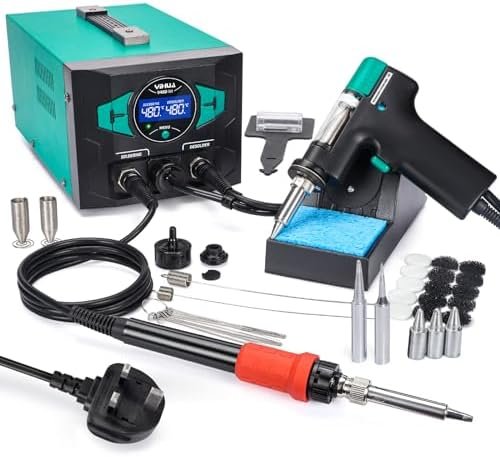
110W iron + powered desoldering gun, both PID-controlled and running simultaneously, 0.05MPa continuous suction. Best for multi-pin sockets, rows of components, and professional/high-volume repair work.
Frequently Asked Questions
Is a desoldering pump enough for hobbyist use?
For most hobbyist work, yes. Removing occasional through-hole components, correcting mistakes, or salvaging parts from a donor board doesn’t require the continuous suction or dual-tool setup of a full station.
When do I actually need a desoldering station instead of a pump?
When you’re regularly removing multi-pin components (DIP sockets, connectors), working through rows of joints on the same board, or doing repair work professionally where speed and reliability matter more than upfront cost.
Can I use a desoldering pump and a separate soldering iron instead of buying a station?
Yes — that’s essentially what the 929D-V replaces the need for, combining both in one handheld tool. It’s a reasonable middle ground if you don’t want to buy a full desoldering station but need more than a manual solder sucker.
Does either come with a warranty?
Yes, both are backed by Neo Soldering’s 12-month warranty and 60-day returns.
Can a desoldering pump damage a circuit board?
Only through technique, not the tool itself. The real risk is repeated reheating of the same joint after a failed first attempt, which stresses pad adhesion over multiple cycles. A powered vacuum pump reduces this risk versus manual tools by clearing solder more completely on the first pull.
Desoldering pump vs solder wick, which is better?
Solder wick is cheaper (often under £5) and fine for occasional single joints, but needs more heat exposure and technique to get a clean pull. A powered pump like the 929D-V clears solder faster with less repeated heating, which matters more as you do this regularly.
Browse the full range of soldering accessories and rework stations.
Browse Soldering Accessories →