

A bench power supply lets you test boards and components with controlled voltage instead of guessing with a battery, spotting shorts by watching current draw, and powering devices during diagnostics without risking damage from an unregulated source. Here are 3 in-stock options across diagnostic, standard repair, and heavy-duty tiers.
Quick answer: for phone diagnostics and boot testing, the SUNSHINE P5 (£29.90) covers 0–12V at 3A. For general repair bench work, the SUGON 3005PM (£165) gives you 0–30V at 5A with USB testing ports. For heavy-duty loads like laptop motherboards, the SUGON 3010PM (£445) doubles the current to 10A.
UK stock · dispatched within 2 business days · free UK shipping on every order · 60-day returns · 12-month warranty
- 1SUNSHINE P5— Best for Phone Diagnostics, £29.90
- 2SUGON 3005PM— Best All-Round Repair Bench Supply, £165.00
- 3SUGON 3010PM— Best for Heavy-Duty Loads, £445.00
The 3 Best DC Power Supplies for Bench Testing
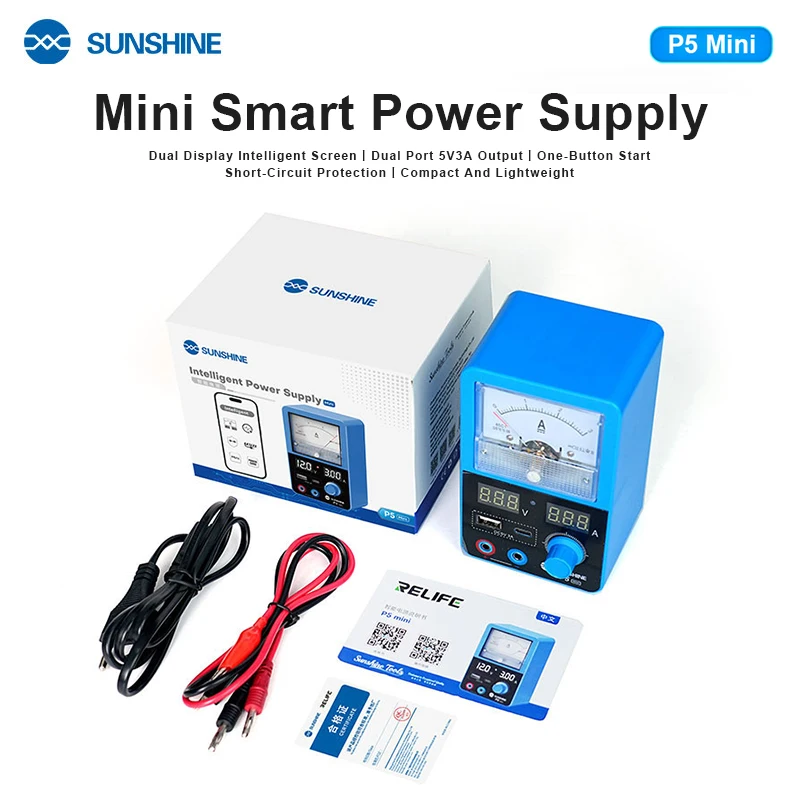
SUNSHINE P5, Best for Phone Diagnostics
0–12V, up to 3A (45W) · dual digital + analogue display · USB-C/USB-A
Bypass the battery, apply controlled voltage, and watch the current draw in real time to isolate faults fast. If a board pulls current and stops, you’re looking at a short; if it draws nothing, the power circuit needs attention. External power-on cable support connects directly to battery terminals for boot testing.
Best for: phone repair diagnostics, no-power/no-boot troubleshooting, mobile toolkits
Key Features:
- 0–12V adjustable, up to 3A
- Dual digital + analogue readout
- Short/over-voltage/over-charge protection
Best Applications:
- Phone no-power diagnosis
- Battery bypass testing
- Small board fault isolation
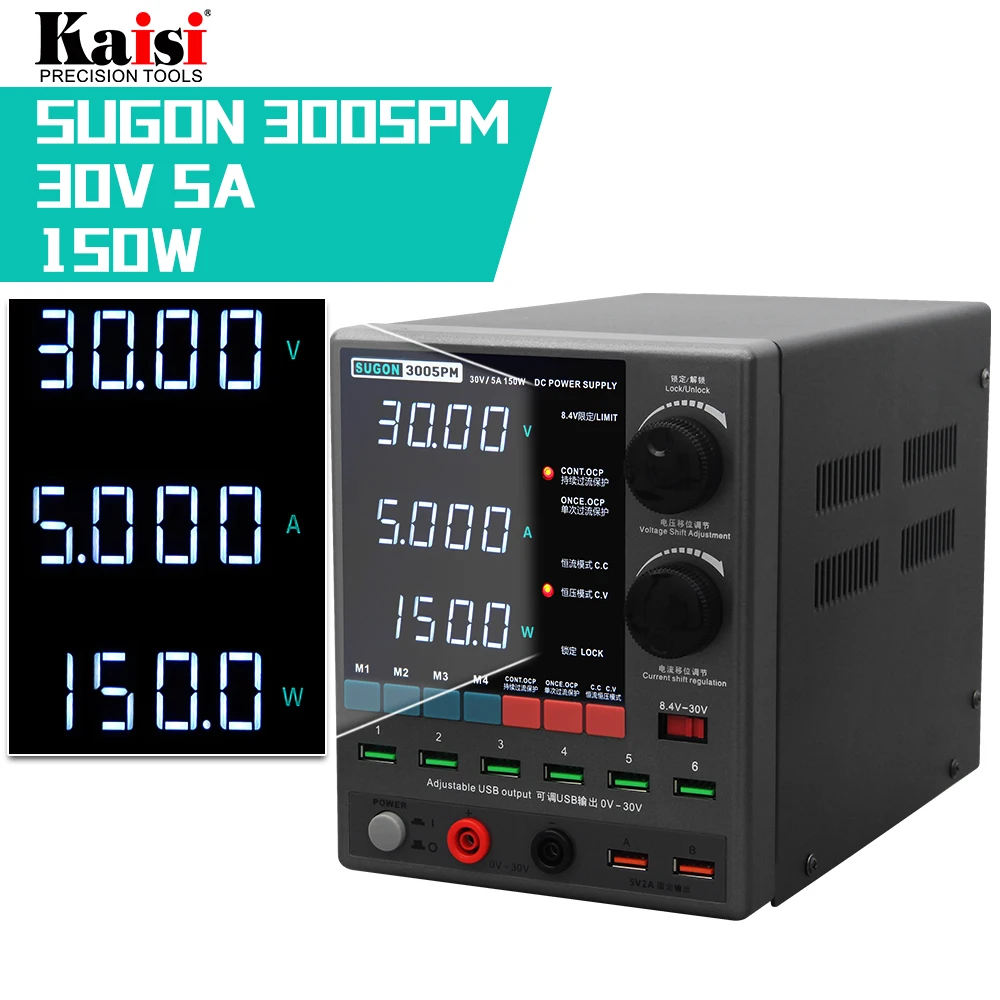
SUGON 3005PM, Best All-Round Repair Bench Supply
0–30V, 0–5A, 150W · 4-digit LED display · 6 adjustable + 2 fixed USB ports
Built around what repair techs actually use daily: 4 memory presets for common voltages, a toroidal transformer for spike-free output, and enough USB ports to test charging circuits and power multiple devices simultaneously without extra adapters. Full protection against over-voltage, over-current, over-power, and over-temperature.
Best for: phone repair, laptop board diagnostics, general electronics testing
Key Features:
- 0–30V, 0–5A continuously adjustable
- 4 memory preset buttons
- 6 adjustable + 2 fixed 5V/2A USB ports
Best Applications:
- Phone charging circuit testing
- Laptop board diagnostics
- Shorted-component detection
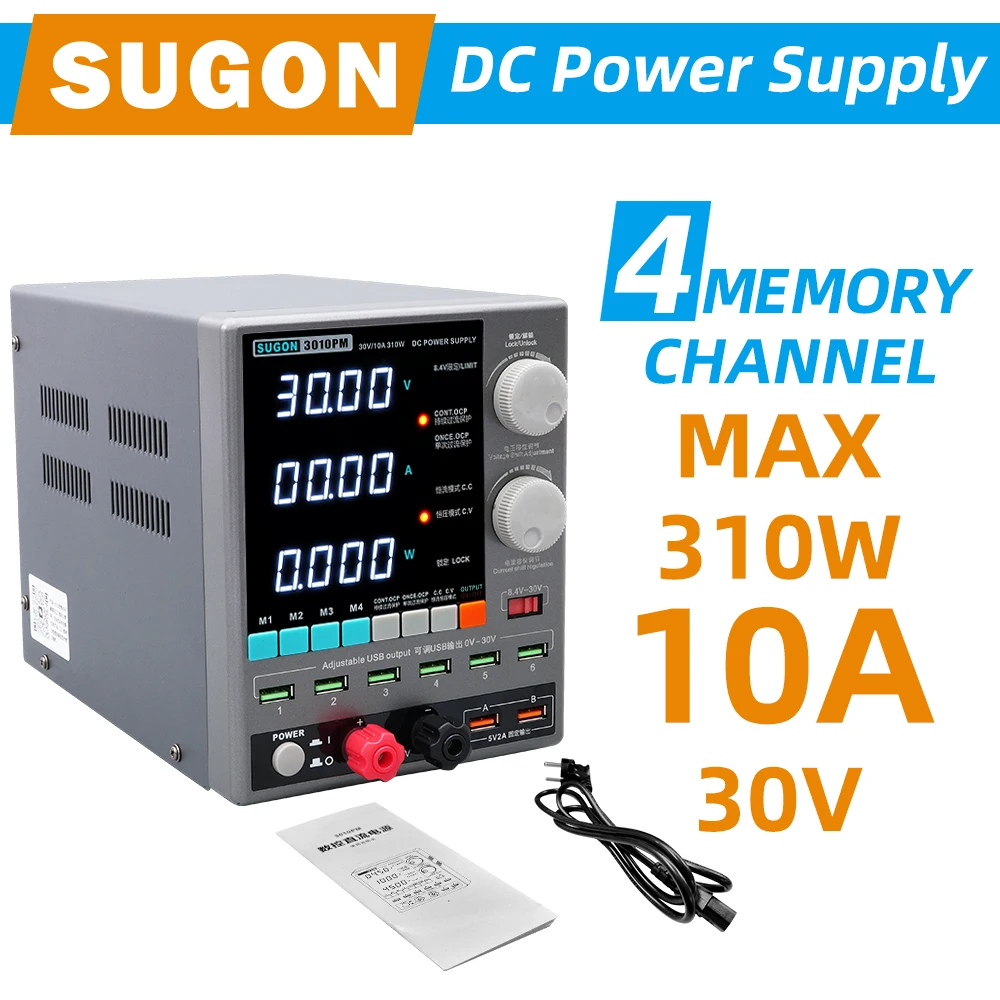
SUGON 3010PM, Best for Heavy-Duty Loads
0–30V, 0–10A, 300W · three-phase design · programmable control
Doubles the current capacity of the 3005PM for work that pushes smaller supplies to their limits — powering laptop motherboards, testing high-current devices, and running extended diagnostics. The three-phase design keeps output stable even under heavy sustained load, with programmable settings for repeatable testing across multiple boards.
Best for: laptop motherboard repair, high-current testing, professional repair shops
Key Features:
- 0–30V, 0–10A, 300W max
- Three-phase stabilised output
- Programmable, repeatable settings
Best Applications:
- Laptop motherboard repair
- High-current device testing
- Professional repair shops
Comparison Table
| Power Supply | Price | Output | Best For |
|---|---|---|---|
| SUNSHINE P5 | £29.90 | 0–12V, 3A, 45W | Phone diagnostics, boot testing |
| SUGON 3005PM | £165.00 | 0–30V, 5A, 150W | General repair bench work |
| SUGON 3010PM | £445.00 | 0–30V, 10A, 300W | Heavy-duty, high-current loads |
Frequently Asked Questions
What is a bench power supply used for?
Testing boards and components with controlled, adjustable voltage instead of a battery or unregulated adapter. You can spot shorts by watching current draw, safely power devices for diagnostics, and repeat tests with identical settings.
What amperage do I need for phone or laptop repair?
3A covers most phone diagnostics. 5A handles general repair bench work including most laptop boards. 10A is for heavy-duty or extended diagnostic work where a smaller supply’s current limit becomes a bottleneck.
Why does voltage range matter?
0–30V covers the vast majority of consumer electronics testing, from phone boards (typically under 5V) up to higher-voltage laptop and industrial applications. A narrower range like the SUNSHINE P5’s 0–12V is fine for phone-focused work but won’t cover higher-voltage testing.
Do I need memory presets on a power supply?
They’re a convenience feature, not a requirement — useful if you’re repeatedly testing at the same voltages (common phone/board test points) and want to avoid re-dialling settings each time.
Browse the full range of bench power supplies and test equipment.
Browse Soldering Accessories →