

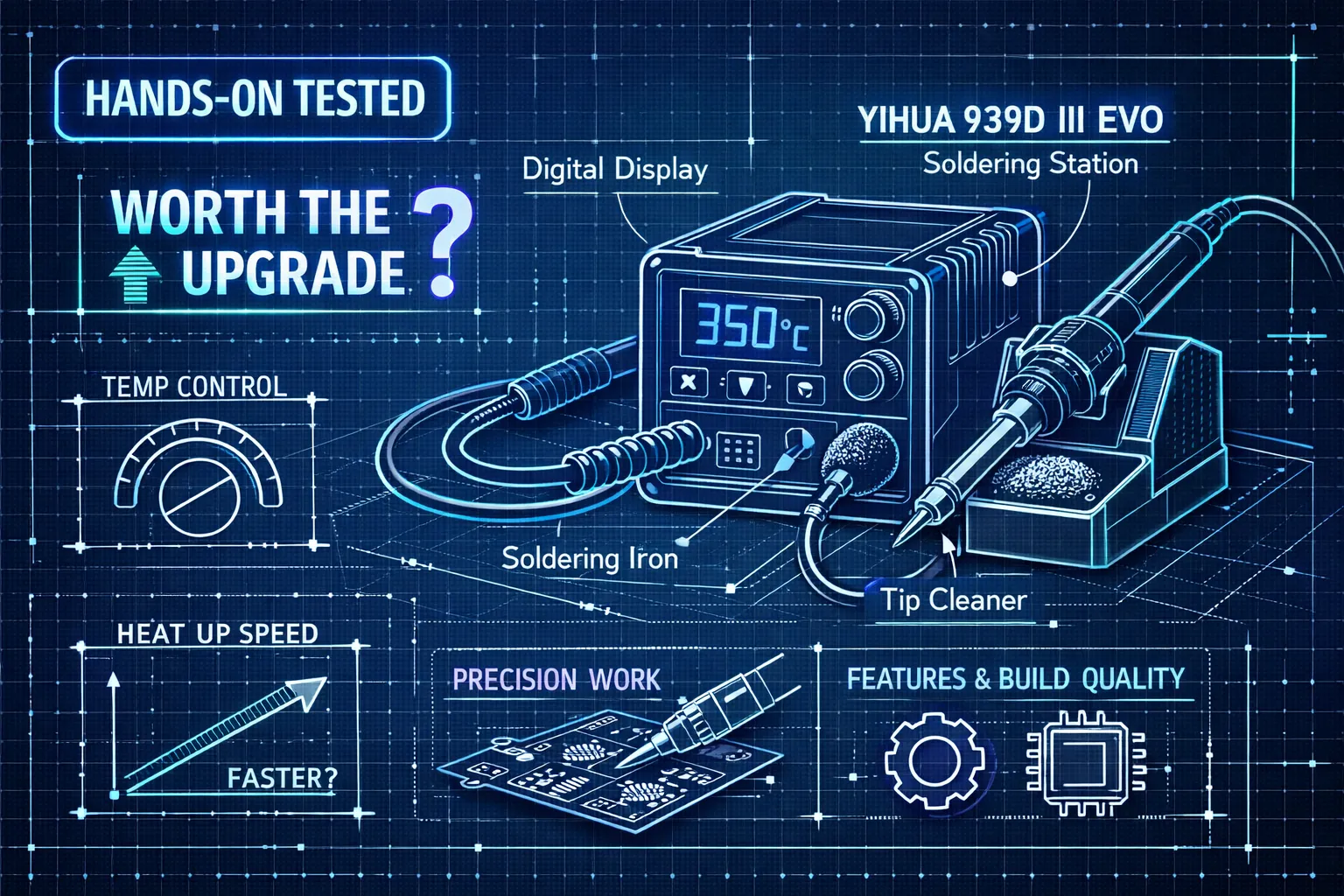
Quick verdict — yes for hobbyists, skip for heavy pro work
If you want a fast‑heating, fully digital station without spending a fortune, the YIHUA 939D III EVO is a very tempting buy. It gives modern conveniences—PID control, memory presets, fast ceramic heating—and practical performance that handles most hobby and light rework work easily. If your bench sees long, continuous runs or high‑volume device repair, you’ll likely prefer a Hakko or an FX‑888D class unit for proven longevity and the premium “feel.”
At Neo Soldering we see both sides: the EVO delivers modern features at a budget price, but it also shows the typical trade‑offs of clone stations (occasional fit and finish issues and tip fit variability). Read the test notes below and run the quick thermocouple check we explain before you decide.
1. Who the EVO is actually for
Short answer: a strong budget pick for hobbyists, students and light rework. It’s a convenient digital upgrade if you want fast heat‑up, PID stability and memory channels without paying for a genuine Hakko. The 110 W ceramic element gives real thermal punch for small boards and reasonable ground planes, and the sleep mode helps extend tip life between jobs.
Don’t buy it if your day job depends on every minute of uptime and you need decades of proven reliability and tactile refinement. For repair shops and heavy lab use, choose a higher‑end model and keep the EVO as a spare or training station.
If you’re in the UK and want to reduce risk, Neo Soldering backs purchases with 5–7 day delivery, free shipping over £50, secure checkout and a 1‑year warranty plus 60‑day returns—useful if you want a quick swap or refund.
2. What it is — specs, features and what’s in the box
The EVO is a digital station built around a ceramic heater and a claimed 110 W power rating. Typical operating range is roughly 200–480 °C (392–896 °F). The front LCD shows set and actual temperature, and the station provides PID temperature control, four user memory channels and an adjustable sleep timer.
Most retail kits include the station, the iron and cord, three assorted tips, a holder and an X‑2 style holster with cleaning area; many consumer bundles add a helping hands kit with magnifier and LED. Be alert for voltage variants—many listings are 110–127 V; check the SKU for your region before ordering.
Specs from different sellers vary: some claim tight static stability (within a degree), others list a wider ±10 °C tolerance. That inconsistency matters in practice—trust the hardware, but verify the particular unit you receive with a quick thermocouple check (next section).
3. Real bench performance — heat‑up, accuracy and how to check it yourself
Video demonstrations reliably show very fast heat‑up to common presets (350–400 °C) and brisk thermal recovery, which aligns with the EVO’s high watt figure. What’s missing are head‑to‑head lab measurements against a calibrated Hakko, so it pays to test your own unit on arrival.
DIY bench test (simple and reliable)
- Secure a K‑type thermocouple to the iron’s tip with Kapton tape (make sure the thermocouple bead is near the tip face).
- From a cold start, set the station to 350 °C and time how long the display takes to reach target.
- Place the tip on a 10×10 mm grounded pad and measure recovery time back to set temperature. Record the set vs actual temperature under load.
- Repeat with a large ground plane or big through‑hole joint to see thermal capacity and recovery time.
- Test sleep: set sleep at 5–10 minutes, allow the iron to enter sleep, then wake it and time recovery back to working temperature.
Numbers to expect: heat‑up to 350 °C typically takes only seconds (often under 15 s); small‑pad recovery is usually 1–3 s; large pads will take longer. Watch for set/actual discrepancies under load—large drifts suggest calibration or control limits.
Quick calibration tip: use the station’s calibration or offset menu and adjust until the thermocouple and display agree within a few degrees. If the unit can’t be calibrated to within 5–10 °C under load, consider exchanging it.
Bottom line: the EVO’s speed and PID give excellent day‑to‑day performance for hobbyists and light professional work, but verify the individual unit with the short test above to avoid surprises.
4. Tip compatibility, recommended tips and temperature settings
The EVO commonly uses YIHUA 902‑style tips. Some Hakko 900‑series tips will physically fit, but they can be loose or require adapters—expect variability by supplier. If you want longer life and consistent fit, check compatibility before buying replacement tips; you can find common replacement handles and tip assortments from specialist vendors that list YIHUA‑compatible parts.
For general electronics work choose a 2.4 mm chisel (screwdriver) for most through‑hole and mixed SMD tasks; use 1.2–1.6 mm chisel or small conical tips for fine SMD pads; bevel or dragger tips are useful for multi‑pin gull‑wing devices and quick drag‑soldering.
Practical temperature guidance: for lead‑free SAC305 solder, run roughly 340–370 °C and keep contact times short with fresh flux; for Sn63Pb37 leaded solder, 300–320 °C is safer. For delicate jewelry or tiny components choose the smallest practical tip and lower temperatures—watch dwell to avoid pad lift.
Tip care extends life: pre‑tin new tips, clean on brass‑wool rather than a wet sponge, always tin before storage, and use sleep mode instead of leaving the iron at full temperature for long periods. For commonly used replacement tips and handles see the YIHUA‑902 parts pages and tip assortments from specialist retailers.
5. Reliability, common faults and maintenance
User reports cluster around modest fit and accessory issues rather than catastrophic failures. Common notes: tips that feel loose, and flimsy helping‑hands or magnifier mounts in low‑cost kits. There are occasional quality control hits where a unit arrives with temperature inconsistency—these are resolvable under warranty or by swapping the unit; community testing and discussion threads can help identify widespread problems.
Small fixes: ensure the tip collar is tightened correctly, replace the included holder with a sturdier stand if it wobbles, and avoid twisting the lead at the handle to protect strain relief. Preventative maintenance—regular tinning, avoiding long idle periods at high temp, and brief calibration checks—keeps the station reliable.
When to use warranty: if the iron refuses to reach set temperature, shows wildly inconsistent readings vs your thermocouple, or you detect electrical safety issues, document the fault (photos, test logs) and initiate a return. For broader community impressions and user reports see the EEVblog review and discussion. For UK buyers, Neo Soldering offers 5–7 day delivery, secure checkout, a 1‑year warranty and a 60‑day returns window—handy for quick exchanges.
6. Alternatives and a short buying checklist
Match the tool to the user:
Hobbyists and occasional tinkerers: EVO or similar digital clones give the best value for modern features. Educators: prefer robust, warranty‑backed stations or classroom kits and buy from a vendor with clear returns. Full‑time repair benches: choose a Hakko FX‑888D / FX‑951 or classic 936/937 family for proven endurance — or consider YIHUA’s own higher‑end alternatives such as the YIHUA 937D+ Soldering Iron Station, Neo Soldering if you want a similar form factor with different internals. Absolute budget entry: Aoyue/Atten clones are cheapest but expect compromises.
Performance vs durability vs price: the EVO sits in the sweet spot for features and price—faster and more convenient than older analog Hakko 936s, but not quite as proven as an FX‑888D in long commercial use.
Quick buying checklist:
- Confirm the correct voltage SKU for your country.
- Check which tip series the station uses and spares availability — for example, review dedicated YIHUA tip assortments and handles when purchasing spares.
- Verify included tips and whether a better stand/tip cleaner is needed.
- Read returns/warranty terms and factor in shipping time and cost.
If you’re in the UK, check Neo Soldering’s range—dispatched within 2 business days, free UK shipping on every order, secure checkout, competitive pricing and our 1‑year warranty with 60‑day returns make trying a new station lower risk. If you want a model bundled with helping hands and magnifier look at the YIHUA 926LED-IV Soldering Station with Soldering Hands, Neo Soldering or explore cordless options like the YIHUA 928D-IV Cordless Soldering Iron Station Kit, Neo Soldering if portability is important. For a full side-by-side of stations under £100, see our best soldering stations under £100 guide.
Final takeaway
The YIHUA 939D III EVO is a smart, budget friendly digital station that competently covers hobbyists, students and light rework. Verify your unit with the quick thermocouple test, choose compatible tips, and maintain the tip properly; if your work is mission‑critical or high‑volume, invest in a proven Hakko or higher‑end model instead. Want a hand deciding? We’re happy to help at Neo Soldering—fast UK delivery and a solid returns/warranty policy make it easy to test the station risk‑free. For the official product listing and full specs from a specialist retailer see the YIHUA 939D III product page, and if you need replacement handles or 902‑series tips check specialist suppliers’ parts pages for compatibility information.
