

Bench Power Supplies
Bench power supplies provide adjustable, stable DC power for testing circuits, powering projects during assembly, and diagnosing electronic faults. Unlike wall adapters locked to single voltages, these lab-grade instruments deliver precisely controlled output from 0-30V or higher with adjustable current limiting that protects circuits from damage during development. Essential for electronics enthusiasts building Arduino projects, repair technicians diagnosing motherboard faults, and anyone needing reliable power without batteries or fixed-voltage adapters.
Showing all 5 results
-
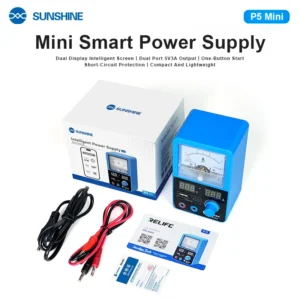
Original price was: £49.90.£29.90Current price is: £29.90.Diagnose dead phones in seconds with real-time voltage and current...Add to cart
-
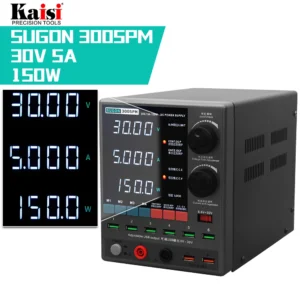
Original price was: £235.00.£165.00Current price is: £165.00.Power your phone and electronics repair with 150W adjustable output,...Add to cart
-
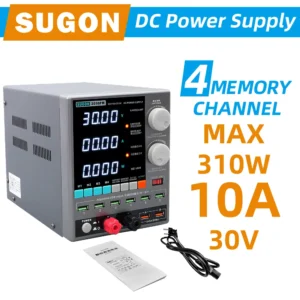
Original price was: £490.00.£445.00Current price is: £445.00.Get serious bench power with 30V/10A output and programmable control...Add to cart
-
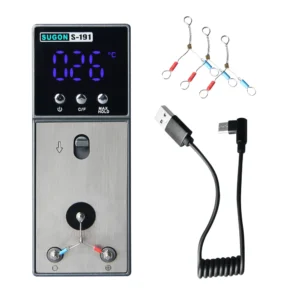
Original price was: £59.00.£44.50Current price is: £44.50.Take control of your soldering accuracy with instant tip temperature...Add to cart
-
Original price was: £159.00.£129.00Current price is: £129.00.Tackle soldering, hot air rework, and circuit testing with one...Add to cart

Precise Voltage and Current Control
Adjustable voltage output lets you match power requirements across different projects without swapping adapters. Turn the dial to provide 3.3V for ESP32 modules, 5V for Arduino boards, 9V for guitar pedal circuits, or 12V for automotive components—all from one instrument. Fine adjustment knobs set voltage in 0.01V or 0.1V increments, crucial when testing voltage-sensitive components or simulating battery discharge conditions.
Current limiting protects circuits during development and troubleshooting. Set the maximum current slightly above normal operating levels, and the supply automatically limits output if a short circuit or design flaw draws excessive power. This protection prevents component damage and trace burnout that would occur with unregulated power sources. Watch the current display to spot problems—abnormally high draw indicates shorts or incorrect component values before smoke appears.
Dual-channel supplies provide two independent outputs simultaneously. Power a microcontroller at 3.3V on channel one while supplying 12V to motor drivers on channel two, eliminating the need for multiple power supplies or onboard regulators during prototyping. Some models offer series and parallel connection modes—series doubles voltage for testing higher-voltage circuits, parallel increases current capacity for power-hungry loads.
Digital displays show both voltage and current in real-time with three or four-digit precision. Unlike analog meters requiring interpretation, LED or LCD readouts provide exact values at a glance. See immediately when circuits draw expected current or when something’s wrong. Memory presets store frequently-used voltage/current combinations for quick recall—no manual adjustment each time you power up common projects.
Testing and Diagnostic Applications
Circuit board repair demands controllable power for safe testing. Apply gradually increasing voltage while monitoring current draw to identify damaged components without destroying additional parts. Short circuits reveal themselves through immediate current limiting before components overheat. This diagnostic approach saves expensive components and provides insight into failure locations.
Component testing under controlled conditions verifies specifications and identifies counterfeit or marginal parts. Apply rated voltage to suspect capacitors while monitoring current for leakage. Test voltage regulators across their input range to confirm proper output regulation. Verify LED forward voltages and draw current to spot incorrect parts in purchased lots. Bench supplies provide the stable, adjustable power these tests demand.
Battery simulation lets you test how circuits behave as power depletes. Slowly reduce voltage from 4.2V down to 3.0V to verify a battery-powered device operates correctly across the full discharge curve. Monitor current draw at different voltages to calculate runtime estimates. This testing catches brown-out problems and reveals power management issues before committing designs to battery operation.
Automotive electronics development requires 12-14.4V power matching vehicle electrical systems. Bench supplies simulate cranking voltage drops, alternator charging conditions, and worst-case undervoltage scenarios. Test car audio amplifiers, LED lighting controllers, and custom gauge clusters with precise voltage control that prevents expensive failures during installation. The current limiting protects both your supply and automotive electronics from wiring mistakes.
Integration with Soldering Workstations
Many professional rework stations integrate bench power supplies directly into soldering station housing. YIHUA 853D and similar 3-in-1 units combine soldering iron, hot air station, and DC power supply in one compact footprint. This integration saves bench space while keeping essential tools within arm’s reach during repair work.
The convenience of integrated power becomes apparent during component-level repairs. Solder in a replacement IC, then immediately power the board for testing without reaching across the bench or switching equipment. Diagnose failures by checking voltage rails with the multimeter while the soldering iron remains hot for quick component swaps when problems appear.
Standalone bench supplies offer higher specifications than integrated units—greater voltage ranges, higher current capacity, and better regulation. Dedicated laboratory-grade supplies deliver the precision needed for sensitive analog circuits, RF work, and applications where ripple and noise matter. Consider your actual needs—hobbyist Arduino projects rarely require the capability of premium standalone supplies.
Space-constrained workshops benefit from integrated solutions. Students in shared makerspaces, apartment dwellers with limited bench area, and mobile repair technicians appreciate the efficiency of one unit handling multiple functions. The unified control interface becomes familiar quickly, reducing cognitive load when switching between tasks during complex repairs.
Key Specifications and Features
Voltage range determines what projects the supply can power. Entry-level units typically provide 0-30V, suitable for most electronics work including Arduino projects, LED circuits, and general hobby electronics. Higher-end supplies offer 0-60V or more for testing automotive systems, tube amplifiers, and industrial electronics.
Current capacity must match your project requirements. Small microcontroller projects draw under 500mA, easily handled by any bench supply. Motor controllers, power amplifiers, and LED arrays demand 3-10A supplies. Check your maximum expected draw and select supplies with at least 20% overhead. Inadequate current capacity causes voltage to sag under load, creating mysterious circuit problems.
Regulation quality affects sensitive circuits. Load regulation specifies how much voltage changes as current draw varies—better supplies maintain tighter control. Line regulation indicates stability when input mains voltage fluctuates. For digital circuits and basic hobby work, moderate regulation suffices. Analog audio, precision sensors, and RF circuits need supplies with superior regulation specs.
Ripple and noise matter for audio and radio frequency applications. Even small AC components on DC output can cause problems—audible hum in amplifiers, interference in receivers, erratic sensor readings. Quality supplies specify ripple below 1-5mV RMS. Budget units may not specify ripple at all, indicating it’s probably higher than you’d prefer for sensitive work.
Protection Features and Safety
Overvoltage protection (OVP) prevents accidentally applying excessive voltage to circuits. Set OVP slightly above your target voltage, and the supply shuts down if voltage exceeds the limit. This catches knob-turning mistakes before destroying expensive components or entire PCBs. Essential when working with sensitive ICs, MOSFETs, and other components that fail instantly above rated voltages.
Overcurrent protection (OCP) shuts down output when draw exceeds set current limit. Unlike current limiting that maintains output while restricting current, OCP completely disconnects power. This distinction matters—current limiting shows you there’s a problem while letting the circuit continue running, while OCP requires manual reset after clearing the fault. Choose behaviour based on your testing approach.
Thermal protection prevents damage to the supply itself during extended high-power operation. Internal sensors monitor temperature and reduce output or shut down before overheating damages components. Quality supplies handle rated output continuously without throttling, while budget units may overheat during sustained use at maximum specifications.
Short circuit protection saves both the supply and your circuit when wiring mistakes create dead shorts. The instant shutdown prevents damaged output stages, blown fuses, or worse. Simply disconnect the short, reset the supply, and continue work without equipment damage or safety concerns.
Frequently Asked Questions
What voltage and current do I need for electronics projects?
Most hobby electronics projects operate at 3.3V, 5V, or 12V with current requirements under 2A. A bench supply providing 0-30V at 3-5A handles Arduino builds, Raspberry Pi projects, custom keyboard assembly, LED circuits, and general prototyping work. This range covers 90% of hobbyist and repair scenarios without excessive capability that inflates cost.
Higher current capacity (5-10A) suits motor controllers, audio amplifiers, and LED strip testing. Voltage above 30V addresses automotive work at 12-14V with headroom, tube amplifier development requiring higher voltages, and industrial equipment diagnostics. Match specifications to your actual projects rather than buying maximum capability “just in case”—unused capacity just costs money.
For occasional use or tight budgets, even a basic 0-30V 3A supply transforms your capability compared to fixed-voltage wall adapters. You can always upgrade later if specific projects demand higher specifications. Start with what handles current work, then expand as needs develop.
Can I use a bench power supply instead of batteries during development?
Bench supplies provide superior development experience compared to batteries. Adjust voltage instantly to simulate full charge, nominal, and depleted conditions without waiting for actual discharge. Monitor current draw precisely to optimize power consumption and calculate runtime. Eliminate battery swapping that interrupts workflow during extended development sessions.
The stable output reveals circuit behaviour without battery voltage variation confusing results. Debug with confidence knowing power remains constant while you change code or modify circuits. Some issues only appear at specific voltages—bench supplies let you hold exact test conditions rather than waiting for batteries to reach particular states.
However, final testing must include actual batteries since supplies can’t perfectly simulate battery internal resistance and voltage sag under load. Circuits drawing pulsed current may behave differently with batteries versus supplies. Use the bench supply for development and optimization, then validate with real batteries before considering designs complete. This hybrid approach combines efficient development with realistic final testing.
Do I need a bench power supply if I have a soldering station?
Bench power supplies and soldering stations serve different purposes despite some overlap in integrated units. Soldering stations deliver heat for joining components—bench supplies provide controlled power for testing those components after installation. Both tools prove essential for complete electronics capability.
If you’re only assembling pre-designed kits with fixed voltages, you might not need a dedicated bench supply—use appropriate wall adapters for testing. However, anyone developing original circuits, modifying existing designs, or performing diagnostic repairs benefits enormously from adjustable power with current limiting. The ability to control voltage precisely and protect circuits from power-related damage justifies the investment.
Integrated 3-in-1 stations like the YIHUA 853D provide basic bench supply functionality alongside soldering tools. These suit hobbyists with limited bench space or budgets who need occasional power testing capability. Serious electronics work eventually demands a dedicated quality bench supply with better specifications and features than integrated units offer. Consider starting with an integrated unit, then adding a standalone supply as projects grow more demanding.
Showing all 5 results