

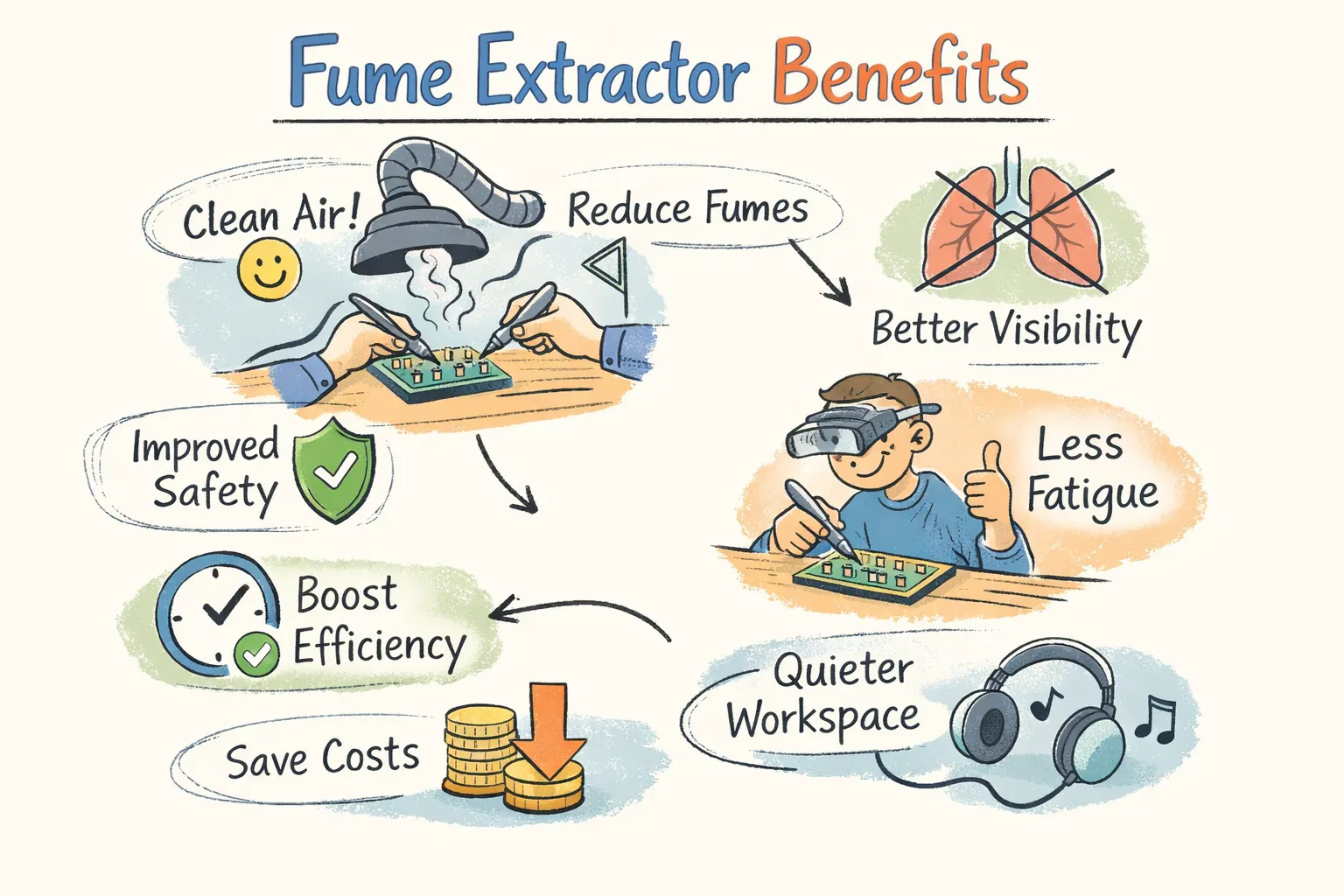
If you solder with any regularity—daily at a repair bench, weekly on hobby projects, or in a classroom with students—those little wisps of smoke add up to a real problem. The one‑line takeaway: if you solder regularly, especially with rosin flux, a benchtop fume extractor is one of the easiest, highest‑value upgrades you can make to your bench.
At Neo Soldering we’ve fitted hundreds of benches and the common result is the same: fewer headaches, cleaner joints, and calmer workshops.
A quick verdict: do you need a fume extractor?
Decide in 30 seconds by answering three simple questions: how often do you solder, what flux do you use, and where do you work. If you solder daily or for shift‑length periods, if you use rosin (colophony) flux, or if you work in an enclosed room or with multiple people, you should get an extractor.
Three realistic outcomes: if you solder daily, teach classes, or handle rosin flux—definitely buy one. If you solder weekly as a hobbyist or run a small repair bench—probably helpful and worth the investment. If you solder only occasionally outdoors using no‑clean flux—optional.
If you want a time‑saving shortcut, see Neo Soldering’s benchtop picks tailored to each use case; they come with 5–7 day UK delivery, a 1‑year warranty and 60‑day returns so you can try risk‑free.
Seven measurable benefits—health, quality and cost
1. Fewer particles and hazardous gases in the air
True HEPA + activated carbon units remove solder smoke particulates and absorb many VOCs. HEPA is rated at 99.97% for 0.3 µm particles; independent benchtop tests show HEPA units cutting particle counts by roughly 95% in use versus single‑stage carbon foams that can perform far worse. How to measure it: use a particle counter or do a before/after particle count near the joint.
2. Faster reduction in acute symptoms
Users typically report reduced eye, nose and throat irritation and fewer headaches within days of adding source capture. How to measure it: track frequency of complaints or short absences for a month before and after installation.
3. Lower risk of sensitisation and long‑term respiratory problems
Rosin (colophony) fumes are linked to occupational asthma and sensitisation. Capturing fumes at the bench cuts the volume of rosin deposits that can sensitize airways over time. For more on these risks see the hazards of solder fumes. How to measure it: compare workplace exposure results to HSE/NIOSH guidance and monitor any medical surveillance or spirometry records.
4. Fewer reworks and steadier joint quality
Smoke and airborne residues can affect wetting and visual inspection of joints; removing fumes reduces surface films and makes defects easier to spot. How to measure it: log reworks per 100 boards and compare pre/post extractor (shops often report noticeable percentage drops).
5. Longer tip and tool life
Less airborne residue equals fewer deposits on tips and less aggressive oxidation—so you change tips less often. How to measure it: track tip replacement frequency (e.g., tips/month) before and after installation.
6. A cleaner bench and easier QA
With source capture you’ll see less dust and sticky flux residue on benches and PCBs, reducing solvent cleaning and inspection time. How to measure it: measure solvent consumption or record time spent cleaning per week.
7. Measurable cost savings and rapid ROI in many shops
The combined savings from fewer reworks, reduced downtime and lower consumable turnover add up quickly in a professional setting. How to measure it: total the hard savings (rework, downtime, tips) minus annual filter costs to compute payback.
How effective are benchtop extractors in the real world?
Most effective units use staged filtration: a pre‑filter for large particles, a true HEPA element for fine particulates, and an activated carbon bed for VOCs and acidic gases. HEPA reliably captures particulates (99.97% at 0.3 µm). VOC removal is more variable: high‑quality carbon beds work well initially but will saturate and must be replaced.
Independent and manufacturer tests show HEPA units dramatically lower particle counts (examples show ~95% reduction in some benchtop tests) while basic carbon foam systems often leave significant particulate or odor behind. Performance in practice depends heavily on source proximity (closest wins), arm/nozzle design, airflow (CFM) and whether the unit recirculates or vents to outside.
Practical takeaway: choose a source‑capture design (flexible arm or nozzle you can position 6–8 inches from the joint) with both HEPA and a quality activated carbon stage; watch filter life—the carbon bed is the one that ages fastest for VOC control. Manufacturers such as Weller’s solder fume filtration publish practical guidance on filtration choices and service intervals.
Specs that actually matter when you compare units
- Airflow (CFM): compact hobby units ≈30–40 CFM; benchtop extraction targets ≈50–100 CFM depending on arm losses. More CFM improves capture but often increases noise.
- Capture velocity (FPM) & nozzle distance: aim for 2,250–3,800 FPM at the arm with the nozzle 6–8 inches from the solder joint; proximity beats raw CFM every time.
- Filter stages: pre‑filter, true HEPA (99.97% @ 0.3 µm), and a substantial activated carbon bed (bed depth/quality matters). Look for service indicators (LED/pressure gauge).
- Noise & ergonomics: classroom and shop use demands low dB operation and flexible, self‑supporting arms so extraction doesn’t fight the soldering workflow.
- Build & maintenance: easy filter swaps, spare filter availability and robust arm joints make ownership simpler; check for CE/UKCA and LEV compatibility if required.
For hobbyists, a compact HEPA+carbon unit with 30–50 CFM will usually suffice. For single‑tech repair benches pick 50–100 CFM with a well‑placed arm. For classrooms or multi‑tech shops choose higher CFM dual‑arm units with clear service indicators and easy filter supply.
Costs, filter replacements and a simple ROI model
UK retail today for benchtop HEPA+carbon extractors typically ranges from roughly £225 for compact hobby units up to £1,000+ for robust classroom/pro systems. Replacement filter economics vary: pre‑filters might be £5–£20, HEPA+carbon cartridges commonly £30–£160 depending on model and quality.
Typical lifespans (usage dependent): pre‑filters checked/changed every 2–4 weeks under heavy use; HEPA and carbon changed every 3–12 months (replace sooner if odors persist or suction drops). Always follow the manufacturer schedule.
ROI formula (plug and play): Annual net benefit = (savings from fewer reworks + reduced downtime + lower tip/tool replacement + fewer sick days) − annual filter & maintenance cost. Payback (years) = purchase price / annual net benefit.
Sample scenarios (conservative assumptions):
Hobbyist: purchase £250, annual filter £25, modest annual savings (less cleaning, fewer tip changes) £60 → net £35/year → payback ~7 years (comfort + health are main drivers).
Small repair shop: purchase £650, annual filter £150. If the extractor halves rework on 2,500 boards/year from 5% to 2.5% and each rework costs £15, savings ≈£940; net ≈£790/year → payback ≈0.8 years.
Non‑monetary ROI counts too: compliance with HSE guidance and CDC/NIOSH publications, improved operator wellbeing, and reduced litigation or health surveillance costs are real benefits often overlooked in simple payback math.
Buying & maintenance checklist — plus Neo Soldering picks and service notes
- Confirm your use case and duty cycle (hobby, single repair bench, classroom/multi‑tech).
- Target specs: HEPA + activated carbon, 50–100 CFM for benchtop, arm/nozzle that reaches 6–8 inches.
- Check replacement filter availability and expected costs; prefer units with service indicators. See our Soldering Accessories page for spare filters and consumables.
- Choose an ergonomic arm and low noise for shared spaces; test reach and flexibility in photos or demos.
- Confirm warranty, delivery and returns — Neo Soldering offers 5–7 day UK delivery, a 1‑year warranty and 60‑day returns to make trying a model low risk.
Setup tips: position the nozzle 6–8 inches from the joint and slightly upstream of the rising smoke; avoid putting your head directly over the work. Test capture with a small stick of incense—watch the smoke get pulled into the nozzle.
Maintenance calendar (practical): wipe the extractor and empty trays daily, inspect pre‑filters monthly, check suction and change HEPA/carbon every 3–12 months depending on load, and schedule a yearly service check. Dispose of saturated carbon/HEPA per local waste rules—treat filters as captured contaminants and follow your local authority guidance.
Neo Soldering picks (quick guide): our budget pick is a compact HEPA+carbon hobby unit for occasional use; the mid‑range benchtop is a 50–90 CFM HEPA+carbon unit suited to single repair benches; the classroom/pro model is a higher‑CFM, serviceable dual‑arm extractor built for continuous duty. All come with our standard delivery and warranty terms and support from Neo Soldering if you need help matching a model to your bench. See our YIHUA 948DQ Solder Fume Extractor + Helping Hands as an example of a compact, well‑specified hobby unit.
A benchtop fume extractor is a small step with measurable health, quality and cost wins for most regular solderers. Use the checklist, try a smoke test at your bench, or contact Neo Soldering’s support for a recommendation tailored to your workshop — or browse our Blog for related posts. Visit our Shop for available models and spares.
Read more about the importance of fume extraction if you want deeper background and references.
