

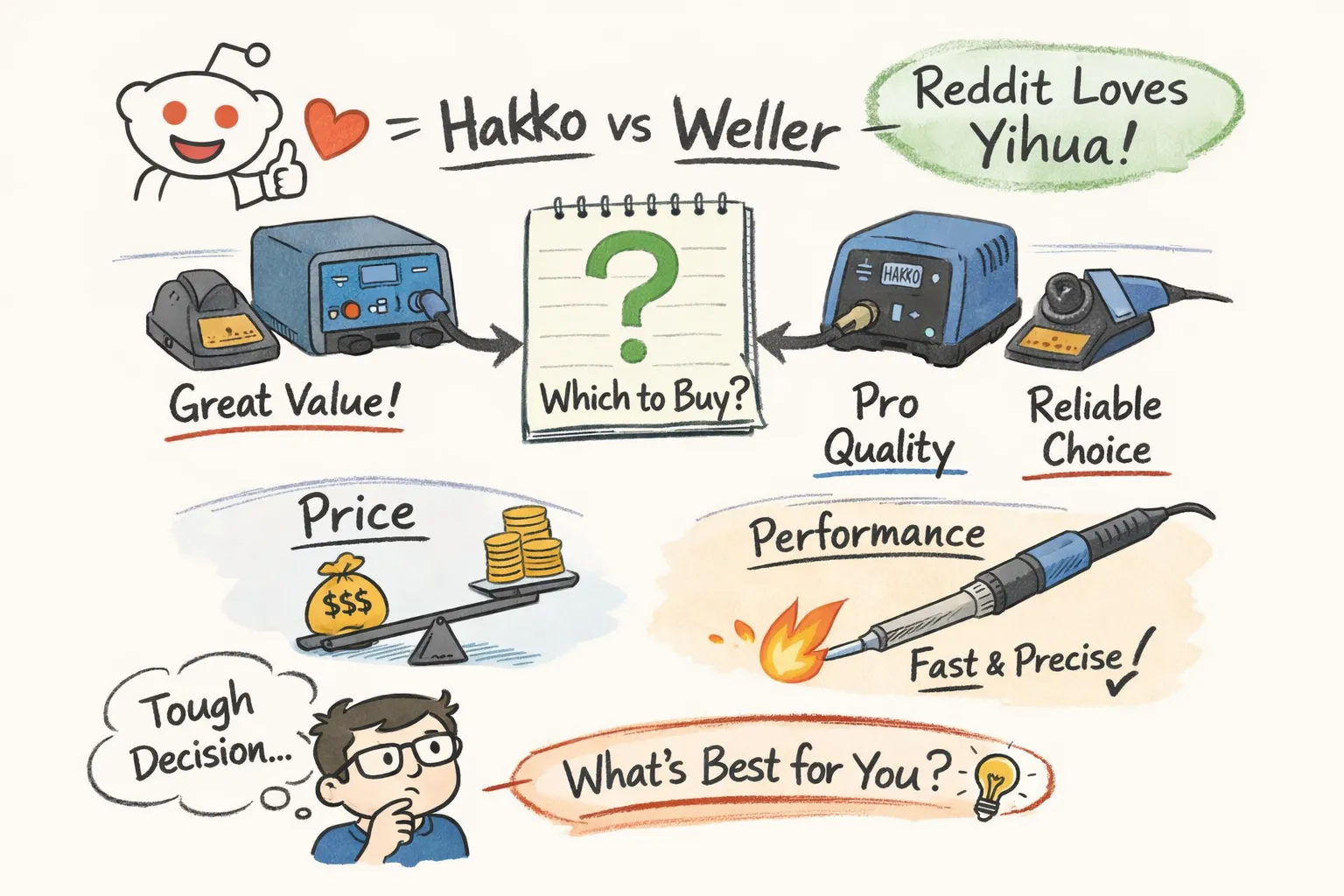
Intro — why Reddit keeps saying “get a Yihua”
Scan a soldering thread and you’ll spot a pattern: someone asks “Hakko or Weller?” and a chorus replies “Yihua is fine, cheaper.” That shorthand hides a clear tradeoff: you can buy a tidy, well‑engineered station that rarely surprises you, or you can buy a much cheaper unit that gives “good enough” results and is inexpensive to repair. At Neo Soldering we help UK customers weigh those tradeoffs every day. Quick verdict up front, followed by the practical differences—tips, heat control, spares and the real costs you’ll care about.
Quick verdict — the short answer for busy buyers
Budget hobbyist / entry‑level: choose a Yihua (examples: 939D+, 853D) — exceptional value and cartridge replacement keeps spare costs tiny.
Long‑term reliability and temperature stability: Hakko FX‑888DX — proven thermal control, broad tip ecosystem and low surprises in daily use.
Ergonomics and pro tip handling: Weller WE1010 — comfortable iron, toolless ET‑series tips and strong aftermarket support.
If you want a pragmatic middle ground: buy a T12‑style Yihua and fit genuine T12 cartridges. Cheap clones are tempting, but genuine cartridges (noticeably pricier than clones) significantly improve consistency.
How these stations differ in practice: tips, heat and spares
Nominal wattage matters less than how heat reaches the tip. Tip system, thermal mass and tip‑to‑heater geometry control recovery under load. Cartridge systems (T12, T15) are compact and fast to swap; traditional tips (Hakko T18 family, Weller ET family) have different thermal profiles and replacement ecosystems.
- Tip system and spare cost — cartridge vs traditional tip compatibility and availability.
- Power and heat capacity — how quickly the iron recovers after heating a large pad.
- Temperature range and stability — set point vs real measured output under load.
- Ergonomics and stand/accessories — the iron’s shape, cable length and the station’s footprint.
- Warranty and spare part availability — ease of sourcing genuine tips or replacement heaters.
Quick model callouts from verified sources: the Hakko FX‑888D/DX uses the T18 family and is noted for tight stability (manufacturer spec ±1.8°F / ±1.0°C static). The Weller WE1010 is an 85 W station with a 70 W iron, ET‑series toolless tips and a 100–450°C range; Farnell datasheets show stability around ±2°C. Several Yihua models support T12‑style cartridges (for example certain 948/938/706 variants), but independent, consistent test data is sparse and clone quality varies.
Why Reddit often recommends Yihua — reading between the lines
Reddit recommendations are pragmatic. Many hobbyists want a compact, inexpensive station that can be fixed by replacing a £2–£5 cartridge and that includes hot‑air and solder in one small footprint. That combination—low upfront cost, easy part swaps and “good enough” performance—maps perfectly to hobby use.
Common pro‑Yihua points seen in threads: affordability, combo hot‑air and solder options, compact desk presence, and replacement parts abundant online. The usual cautions are also common: QC variability between batches, clone cartridges with poor heater/thermocouple bonding, and inconsistent calibration. In short, Redditors are often saying “best value if you’re a hobbyist who can tolerate occasional tinkering.”
Hands‑on performance: what tests say about stability, heat‑up and soldering
Good tests use a thermocouple at the tip, standard tips, a scripted loading routine (large pad heating) and a wetting/joint test at lead‑free temperatures. Using that approach, published hands‑on reviews show a pattern: published roundups and comparisons frequently place Hakko and Weller at the top for stability and ergonomics.
| Model | Heat‑up relative | Stability / recovery |
|---|---|---|
| Hakko FX‑888D/DX | Very quick (reported ~2–3s faster than Weller in some tests) | Tight control; holds set‑point well (manufacturer ±1°C static) |
| Weller WE1010 | Quick, slightly slower than Hakko in some comparisons | Good overall; small dip under heavy load then recovery (stability ~±2°C) |
| Yihua (T12 models) | Variable — depends on cartridge quality and model | Community reports “good enough” for most soldering; controlled lab data limited |
What that means for real tasks: if you do delicate SMD rework or frequent thermal cycling, tighter stability and faster recovery (Hakko) reduce frustration. For occasional DIY, through‑hole or hobby SMD, a well‑set Yihua or Weller delivers excellent joints. Ergonomics matter too—Weller’s handpiece and cable routing often feel less tiring during long sessions.
Buyer’s checklist — choose by use case (and Neo Soldering picks)
Ask yourself: How many hours a week will I solder? Do I need hot‑air? Do I prefer to buy cheap spares or rely on warranty service? Use those answers to pick.
Persona picks:
Hobbyist / kit builder (few hours a month): Yihua 939D+ / 853D — lowest cost of entry and inexpensive cartridges; buy genuine T12s where possible.
Repair technician / daily user: Hakko FX‑888DX — long‑term stability and broad genuine tip availability justify the cost over time.
Educator / shared lab: Weller WE1010 — ergonomic iron, secure tip fit and simple to maintain in classrooms.
Neo Soldering for UK buyers: we stock these ranges and make trying a new station low risk with 5–7 day delivery across the UK, free shipping on orders over £50, secure checkout, a 1‑year warranty and 60‑day free returns. Those policies reduce the downside of trying a budget station. See our selection of Soldering Stations for the exact models we carry.
Accessory bundle to add at purchase (small practical list):
- One set of spare tips (genuine where possible)
- Brass sponge and tip tinner
- Rosen flux and a good solder (lead‑free or Sn63 if you can)
- Fume extractor and an anti‑static mat
Keep it working: maintenance, upgrades and when to step up
Simple maintenance extends life: keep tips tinned when hot, clean with brass wool rather than a wet sponge, avoid leaving the iron set at maximum for no reason, and replace cartridges or worn tips before they ruin joints. If you choose a Yihua, plan to upgrade to genuine cartridges early—this fixes many reliability complaints; independent tests and teardown writeups show genuine T12s often outperform clones in heater and thermocouple bonding (real-world tip comparisons).
For more on routine care and common mistakes, see our guide Avoid Costly Mistakes: Proper Care for Your Soldering Tools. If you want to understand sleep modes and automatic power features that save tip life and energy, our YIHUA 8786D Sleep Mode Explained article is a short, practical read.
When to upgrade from a budget station: if you solder daily, perform heavy SMD rework, or need predictable thermal performance for delicate components, move to a Hakko or Weller. They cost more up front but save time and headaches over months of use.
Quick test checklist when the unit arrives: verify power‑on and temp readout; do a wetting test on a small pad at 300–350°C; swap in a spare tip or cartridge; and, if anything seems off, use the 60‑day returns or 1‑year warranty available from Neo Soldering.
Conclusion — which one should you buy?
Yihua often wins on Reddit because it wins on cost and serviceability for hobbyists. Hakko and Weller win for predictability, ergonomics and long‑term uptime. Use the buyer checklist above: match your daily workload to the station’s strengths, buy the right tips, add a small accessory bundle, and remember that Neo Soldering offers UK buyers fast delivery, free shipping over £50, secure checkout, a 1‑year warranty and 60‑day returns to make trying a budget or premium station low risk.
If you’d like a side‑by‑side of the exact models we stock or a quick phone chat about which tips to order first, visit Neo Soldering or contact our support—happy to help you pick the iron that makes your solder joints painless and repeatable.
